Inheritance Rights and Procedures for Foreigners in Turkey

Foreigners’ Rights Under Family Law in Turkey
Mart 17, 2025
Real Estate Transactions for Foreigners in Turkey and Legal Requirements
Mart 17, 2025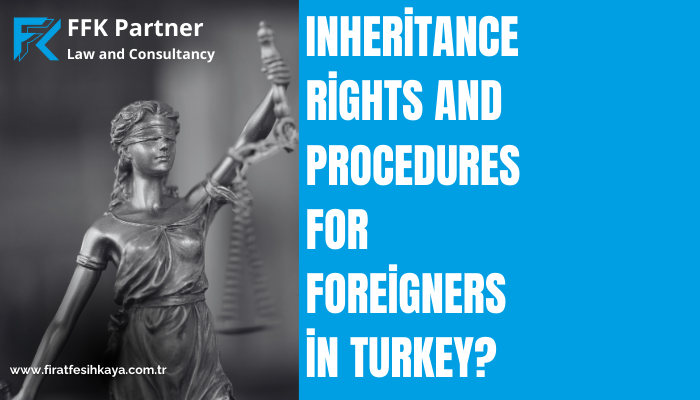
1. Introduction
Inheritance laws in Turkey can be complex, especially for foreign nationals who own assets in the country or expect to inherit from Turkish residents. While Turkish inheritance law primarily follows the Civil Code, foreign laws may also play a role, depending on the nationality of the deceased and the type of assets involved. Understanding these regulations is crucial for foreign investors, expatriates, and those with familial ties in Turkey.
2. Legal Framework Governing Inheritance in Turkey
Turkey’s inheritance laws are governed by the Turkish Civil Code No. 4721 and the International Private and Procedural Law No. 5718 (MÖHUK). The applicable law depends on the nationality of the deceased and the nature of the assets:
- Movable properties (cash, stocks, vehicles, etc.) are subject to the deceased’s national law at the time of death.
- Immovable properties (real estate in Turkey) are governed strictly by Turkish law, irrespective of the deceased’s nationality.
Foreigners must be aware of these distinctions to understand how their estate will be handled upon their passing. Additionally, Turkish law emphasizes forced heirship, meaning that certain heirs, such as children and spouses, have legally protected shares in the inheritance.
3. Can Foreigners Inherit Property in Turkey?
Yes, foreign nationals can inherit both movable and immovable assets in Turkey. However, certain limitations and conditions apply, including:
- Reciprocity principle: Foreign heirs can inherit property in Turkey only if their home country grants similar rights to Turkish citizens.
- Land ownership restrictions: A foreigner cannot own more than 30 hectares (300,000 square meters) of land in Turkey.
- Military and security zones: Certain areas are restricted for foreign ownership due to national security concerns.
Foreign nationals should verify whether their country has a reciprocity agreement with Turkey to avoid inheritance disputes.
4. Inheritance Restrictions for Foreigners
Although foreigners can inherit property, there are significant restrictions, including:
- If the deceased’s home country does not have a reciprocity agreement, foreign heirs may not be able to register the property in their name and may be forced to sell it.
- Properties in military or security-sensitive zones may not be transferred to foreign heirs.
- In case of inheritance disputes, Turkish courts have jurisdiction, and legal proceedings must comply with Turkish inheritance laws.
In some cases, if a foreign heir cannot inherit real estate due to legal restrictions, the property may be sold, and the proceeds transferred to them.
5. How Can Foreigners Claim Their Inheritance in Turkey?
To claim an inheritance in Turkey, foreign heirs must follow a legal process that includes:
- Obtaining a certificate of inheritance (veraset ilamı): This document is issued by Turkish courts or notaries and confirms the legal heirs of the deceased.
- Submitting supporting documents: Foreign heirs must provide birth certificates, passports, and other official documents to prove their relationship to the deceased. These documents often require an apostille certification or consular legalization.
- Tax and legal obligations: Before transferring inherited assets, heirs must pay any outstanding inheritance tax, which varies based on the value of the estate.
- Property registration: If the inheritance involves real estate, the new owner must register it with the local Land Registry Office (Tapu ve Kadastro Genel Müdürlüğü).
6. Inheritance Tax for Foreigners in Turkey
Turkey imposes an inheritance and transfer tax, which applies to both Turkish citizens and foreign heirs. The tax rates range from 1% to 30%, depending on the relationship between the deceased and the heir and the total value of the inheritance.
- Spouses and children pay lower tax rates compared to distant relatives or unrelated individuals.
- Payments can be made in installments over three years.
- If the inherited property is sold, capital gains tax may also apply.
To determine the exact tax obligations, heirs should consult the Turkish Revenue Administration (Gelir İdaresi Başkanlığı): https://www.gib.gov.tr
7. Conclusion
Navigating inheritance laws in Turkey as a foreigner requires an understanding of both national and international legal frameworks. Foreign nationals can inherit assets in Turkey, but they must consider factors like reciprocity agreements, land ownership limitations, and tax obligations. Seeking legal assistance from an expert in Turkish inheritance law is advisable to ensure a smooth and compliant inheritance process.
For official resources and legal support, visit:
- Turkish Land Registry and Cadastre (Tapu ve Kadastro Genel Müdürlüğü): https://www.tkgm.gov.tr
- Turkish Notaries Union (Türkiye Noterler Birliği): https://www.tnb.org.tr
- Ministry of Justice of Turkey (Adalet Bakanlığı): https://www.adalet.gov.tr
For more detailed information and legal assistance, FFK Partner Law Firm provides you with professional support!