Filing for Bankruptcy in Turkey as a Foreigner (2026 Legal Guide)

Concordat (Debt Restructuring) in Turkey Explained (2026 Guide)
Mart 31, 2026
Legal Consequences of Company Insolvency in Turkey (2026 Guide)
Mart 31, 2026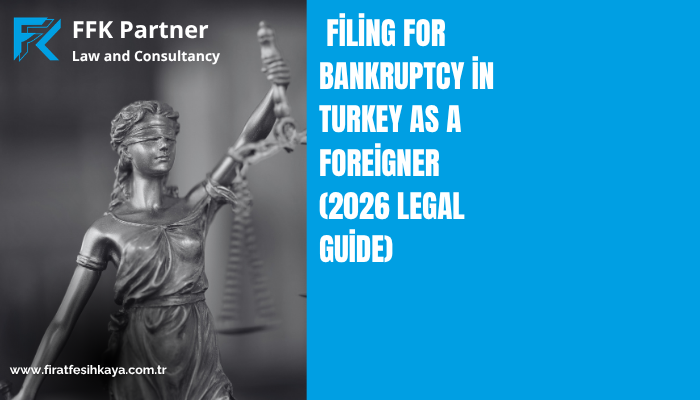
A complete 2026 guide to filing for bankruptcy in Turkey as a foreigner. Learn procedures, requirements, risks, and legal strategies.
Filing for bankruptcy in Turkey as a foreigner involves a structured legal process governed by Turkish insolvency and enforcement laws. For foreign investors, company owners, and commercial actors, bankruptcy is not only a financial issue but also a complex legal procedure that requires careful planning and strategic decision-making.
In 2026, Turkey continues to strengthen transparency, digital case management, and creditor protection in bankruptcy proceedings. While the system is accessible to foreign nationals, the process may present additional challenges due to procedural requirements, language barriers, and cross-border legal issues.
From a legal standpoint, bankruptcy proceedings must be managed within the framework of commercial law, and working with a commercial lawyer is essential to protect rights and minimize risks.
This guide explains how foreigners can file for bankruptcy in Turkey, including eligibility, procedures, legal consequences, and practical strategies.
Legal Framework for Foreign Bankruptcy Filings
Foreigners filing for bankruptcy in Turkey are subject to the same legal framework as Turkish nationals.
The law applies to:
- Foreign individuals engaged in commercial activities
- Foreign-owned companies established in Turkey
- Branch offices of foreign companies
There is no discrimination based on nationality, but procedural compliance is strictly required.
Who Can File for Bankruptcy?
Bankruptcy in Turkey applies primarily to commercial actors.
Foreigners who may file include:
- Company owners
- Shareholders in certain cases
- Commercial individuals
- Corporate entities
The key requirement is insolvency—the inability to meet financial obligations.
Conditions for Filing Bankruptcy
To file for bankruptcy, certain conditions must be met.
These include:
- Existence of due and payable debts
- Inability to pay debts
- Evidence of financial distress
The court will examine whether these conditions are satisfied before accepting the application.
Filing Process Step-by-Step
The bankruptcy process begins with a court application.
The applicant must submit:
- Financial statements
- List of debts and creditors
- Supporting documentation
The court reviews the application and may request additional information.
If the court finds the conditions met, it issues a bankruptcy decision.
Court Proceedings and Decision
The court plays a central role in bankruptcy proceedings.
It examines:
- Financial status of the debtor
- Credibility of claims
- Evidence of insolvency
If satisfied, the court declares bankruptcy and initiates the process.
Effects of Bankruptcy Declaration
Once bankruptcy is declared:
- The debtor loses control over assets
- A bankruptcy administration is appointed
- Enforcement actions are consolidated
This ensures that assets are managed fairly for creditors.
Role of Bankruptcy Administration
The bankruptcy administration is responsible for:
- Managing the debtor’s assets
- Identifying creditors
- Liquidating assets
- Distributing proceeds
This body ensures transparency and fairness throughout the process.
Rights of Foreign Creditors
Foreign creditors have equal rights under Turkish commercial law.
They may:
- File claims
- Participate in proceedings
- Receive distributions
Equal treatment is a key principle in bankruptcy law.
Cross-Border Legal Issues
Foreign bankruptcy cases often involve cross-border elements.
These may include:
- Recognition of foreign judgments
- Coordination with foreign jurisdictions
- Enforcement of claims abroad
These issues add complexity to the process.
Risks for Foreign Applicants
Foreigners face specific risks when filing for bankruptcy.
These include:
- Legal complexity
- Language barriers
- Delays in proceedings
- Potential loss of assets
Understanding the process is essential to mitigate these risks.
Alternatives to Bankruptcy
Before filing for bankruptcy, alternatives may be considered.
These include:
- Debt restructuring (concordat)
- Negotiated settlements
- Payment plans
A commercial lawyer can help evaluate the best option.
Legal Strategies for Foreigners
Effective legal strategies are critical.
These may include:
- Preparing accurate documentation
- Protecting assets
- Negotiating with creditors
- Ensuring compliance with legal requirements
Professional guidance increases the likelihood of a favorable outcome.
Importance of Legal Support
Bankruptcy proceedings involve complex legal and financial issues.
Foreign applicants often require professional assistance to navigate the process.
A commercial lawyer provides:
- Legal advice
- Representation in court
- Strategic planning
- Risk management
Professional support ensures that rights are protected.
Importance of Legal Awareness in 2026
In 2026, increased transparency and digital monitoring have made bankruptcy proceedings more structured but also more demanding.
Foreign investors must understand their rights and obligations to navigate the process effectively.
Legal awareness and proactive planning are essential.
Frequently Asked Questions (FAQs)
1. Can foreigners file for bankruptcy in Turkey?
Yes, they are subject to the same legal framework as Turkish nationals.
2. What are the main requirements?
Insolvency and existence of unpaid debts.
3. What happens after filing?
The court examines the case and may declare bankruptcy.
4. Do foreign creditors have rights?
Yes, they are treated equally.
5. Can assets be seized?
Yes, assets are managed and liquidated.
6. Are there alternatives to bankruptcy?
Yes, such as debt restructuring.
7. How long does the process take?
It depends on the complexity.
8. Is legal support necessary?
Yes, especially for foreign applicants.
Legal Support & Contact
Filing for bankruptcy in Turkey as a foreigner requires careful legal planning and strategic execution. For foreign investors and companies, working with an experienced law firm ensures that your rights are protected and your financial interests are managed effectively.
Professional legal support helps navigate complex procedures, protect assets, and achieve the best possible outcome.
Professional Legal Support – Contact Us
- Phone: +90 312 434 22 22
- WhatsApp: +90 532 769 22 22
- Email: info@firatfesihkaya.av.tr
- Address: Mevlana Blvd. No:221 Yıldırım Tower No:148, 06520 Balgat/Çankaya/Ankara, Turkey